just a brief meditation on the dogma of the trinity today in light of the upcoming birthday of swami abhishiktananda/dom henri le saux in august.
another longer essay in the ongoing saga of generative software/decomputing and higher ed coming soon!
just a brief meditation on the dogma of the trinity today in light of the upcoming birthday of swami abhishiktananda/dom henri le saux in august.
another longer essay in the ongoing saga of generative software/decomputing and higher ed coming soon!
swami abhishiktananda (1910-1973; aka dom henri le saux) was a french benedictine monk and priest who felt called to live in india in order to set up contemplative monasteries there. he ended up staying the rest of his life and discovering more than he had bargained for in the general life of india and particularly in advaita vedanta. he never renounced his vocation as a monk or a priest, and he is said to have achieved final awakening right near the end of his life. i was introduced to swami abhishiktananda by my amma sr. pascaline coff and had the great privilege of collecting and translating his french poems a few years back.
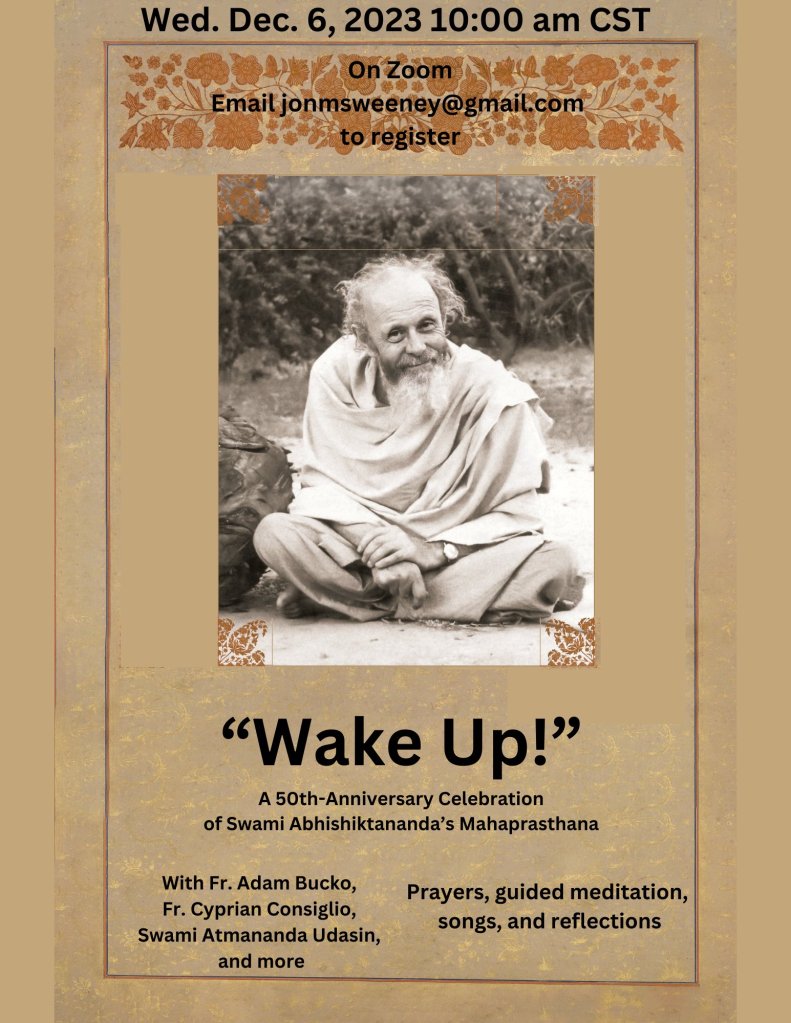
this year on december 7th marks the 50th anniversary of swami abhishiktananda’s mahaprasthana (great departure). several of us who admire swamiji and his message of awakening and interreligious respect and affection will celebrate on december 6th at 10.00 am central standard time.
prior cyprian consiglio, fr. adam bucko, jon sweeney, and others will be gathering on zoom to share meditation, song, and talk on swamiji. if you’d like to attend as well, you can email jonmsweeney@gmail.com to receive the zoom link.
pax/shanti
this year is the 50th anniversary of the passing of swami abhishiktananda, benedictine monk and sannyasi. and i was invited by dimmid to write an essay on how/why swamiji’s life and message are still important and instructive for their journal dilitato corde.
swami abhsihiktananda was, it’s said plenty but bears repeating, a pioneer of interreligious dialogue, leaving his native france in 1948 for india and never returning. his embrace of advaita and his struggle to articulate his spiritual message in terms honest to the reality of his “double belonging” to the church and to the vedantic tradition make him an immensely compelling figure.
as i did with fr. bede griffiths a few months ago, rather than focusing on the more outgoing aspects of swami abhishiktananda’s thought and life, i turned to the foundations of his formation in monasticism. in this essay i look at his close and at times fraught relationship with the psalms.
it was good fun to write, requested as more of a reflection than a scholarly essay, so i placed myself in this one more than i usually do. other interesting takes are being added as the issue fills up in celebration.
requiescat in pace et lux perpetua luceat ei.

A happy St. Benedict’s day to all!
On this big feast for Benedictine and Cistercian monastics and their oblates and associates, I thought I’d post some new audio of Benedictine poetry I’ve translated or edited over the last few years.
Today’s first installment: a short poem from Swami Abhishiktananda (aka Dom Henri Le Saux, OSB; 1910-1973). “OM Wholly Burnt” is a dense little poem with lots of pathos included in a letter to Swamiji’s disciple, Swami Ajatananda (Marc Chaduc) written toward the end of his life.
Here’s the audio:
After an unpremeditated hiatus, I’m back to posting. I’ll be posting some audio files of my own poems from my first poetry collection, Sunk in Your Shipwreck, that came out in October very soon. But for the moment here’s another from Swami Abhishiktananda, the Benedictine-monk-turned-wandering-sannyasi whose poems I translated last year.
In “Shri Ramana Was Great,” Swami Abhishiktananda wrestles with Christ, wondering how this sage of modern India could have such grace though clearly he was not in any formal sense part of Christ’s community that is the Church. (The ashram community responsible for Shri Ramana’s legacy is here; for more on Swamiji’s relationship to Shri Ramana and the holy mountain Arunachala, see my previous post.)
This realization of Shri Ramana’s greatness in the S/spirit was Swamiji’s first real leap into exploring the great Awakening that goes beyond religious affiliation and doctrine. In Shri Ramana, Swamiji found embodied the deep self-realization that he found recounted in the Upanishads, and this challenged his French Catholic upbringing and monastic and priestly formation. The poem here follows his searching, guiding the reader (and, one assumes, himself) to a precarious peace with a situation that doesn’t seem to have an obvious resolution along traditional religious lines. Here it is:
I am very excited to announce the publication of my first poetry collection, Sunk in Your Shipwreck: A Palmer Stammering. It’s now available thru Resource Publications and Amazon.
The book includes poems from the last ten years or so, a number published in journals and magazines but plenty of unpublished material too. I’ll be posting some readings in the coming weeks, but here is the description from the back cover for now:
Sunk in Your Shipwreck is a collection of poems that employs the trope of the pilgrimage to structure its meanderings, especially (in murky and unfaithful ways) echoing the great medieval English poem, Piers Plowman. Moving through a poem from beginning to end is itself a kind of pilgrimage in the mind and on the tongue. The poems here reflect a late modern palmering, a movement from place to place and time to time and back again, movement through language and silence, inner and outer states, contemplative and active, starting and stopping, a longing for a constant or a destination in a life of uncertain circumstances and goals. In this verse peregrination, the palmer seeks out an illuminating and sustaining vision to form and transform common surroundings and moments of human life, a pursuit that is hopeful and darkly radiant by turns.
Here is another reading of one of my translations of Swami Abhishiktananda’s poems. This piece, “Bhairava,” is one of my favorite of Swamiji’s poems. The Sanskrit adjective “bhairava” means “frightful/terrible/etc.” and it is also the name of a deity recognized in Hinduism and various schools of Buddhism, especially associated in Hinduism with Shiva. Bhairava is then a frightful face of Shiva, having to do with dissolution and annihilation. Swamiji composed this poem during his month-long silent retreat at Kumbakonam, a town in Tamil Nadu, India in November of 1955.
Swami Abhishiktananda uses this title of Shiva as a novel way into some well-trodden tropes in the mystical poetic toolkit: abandonment, ravishment, desolation and dissolution, union-as-annihilation-of-the-self. The poem speaks to the terror and lonesomeness of the radically contemplative life and the experience of non-dualism within human consciousness–even as union is experienced, a lingering sense of the individual endures and can cause disturbance.
But beyond the surface of these frightful images and emotional states, one can also see the playful use of such imagery to paradoxically gesture toward profound states of consciousness that simply don’t “come out” in direct expression. Though Swamiji’s imagery here is distraught and painful–even calling his addressee an “Ogre” at one point–it points to a state of unknowing that is “tender and heartrending at once,” heartrending as long as there is some part of the identity that is clung to, at any rate.
In 1948, Dom Henri Le Saux, a Benedictine Monk, left his native Brittany and arrived in Southern India. He intended to establish the contemplative monastic life in the Indian church, a life dedicated to sacred silence in a land imbued with sacred silence.
Though he was sympathetic to Hindu philosophy, especially the ideas and experiences described in the Hindu scriptures known as the Upanishads, he still assumed that he would be converting others to the Christian way during his time in India. Yet when he encountered the simple faithful and the contemporary sages in his new homeland, he found the Spirit at work there, beyond the borders of institutional Christianity and any Christian faith whatsoever. This led him to dramatically reevaluate his “mission” in India and his very understanding of all R/reality.
This reevaluation was especially spurred by his encounter with the Self-realized sage Shri Ramana Maharshi (shortly before Shri Ramana’s leaving the body in 1950) and the sacred mountain where Shri Ramana lived, Arunachala. In Shri Ramana, Swami Abhishiktananda saw the heights of contemplation and divine union of his own Catholic Christian tradition lived in an authentic way, and he spent several retreats living in the caves of Arunachala and getting to know the hermits who lived there, the members of Shri Ramana’s ashram community, and those who lived in the adjacent town, Tiruvannamalai.
In the caves of Arunachala, Swami Abhishiktananda spent long hours in silence and experienced deep states of meditation. As Swami Atmananda Udasin, the director of the Abhishiktananda Centre for Interreligious Dialogue, says, “there [he] had his first great mystical insights. Later in his life, he would refer to the Mountain as his place of Awakening: ‘But as for myself, like Shri Ramana, it was Arunachala that awakened me. Oh, that Awakening!'”
The larger part of my new book, In the Bosom of the Father: The Collected Poems of a Benedictine Mystic, is comprised of the poems that Swami Abhishiktananda composed in light of his experiences in those first few years in India, especially in his encounter with Arunachala as well as Swami Abhishiktananda’s “renderings” of Shri Ramana’s Tamil poems. The first in the collection, Aruncachala, he described as being “sung to me by Arunachala one night before I went to sleep, and I relit my lamp several times to catch it. Perhaps it will convey some of the spell cast on me by Arunachala.” Below is a reading of my translation of Swami Abhishiktananda’s poem, and Swamiji’s own note for context.
“Arunachala is a holy place of particular veneration in Tamil Nadu in the South of India. The Puranas . . . tell of its origins. There was a quarrel between Brahma and Vishnu, each claiming that he was the First and Greatest. Suddenly, a Column of Fire appeared in the space between them. They decided that whoever first found either the foundation or the summit of this mysterious Column would be accepted by the other as the superior. Brahma dashed to the summit, while Vishnu began to dig into the earth, but both had to admit the vanity of their efforts. It was Shiva who had manifested themselves to them, convincing them of the futility of their former claims, for the greatest and first in Being is Shiva. The Column of Fire later turned into a Mountain of sapphire, and finally a Mountain of stone. Each year during the full moon of the month of Karttikai (15 November-15 December), an immense fire is lit on the summit of the Mountain, which is called the feast of Dipam (“dipa” in Sanskrit; “lamp” in English). The Tamil name for the city there is Tiruvannamalai.” (In the Bosom of the Father, 23.)
 Jacob Riyeff