thanks to aaron lelito for the fun conversation! we talk kerouac and ginsberg, burning adolescent poems, old english as mother tongue, scholarship and art, earth and epistemology, and the artistic process.
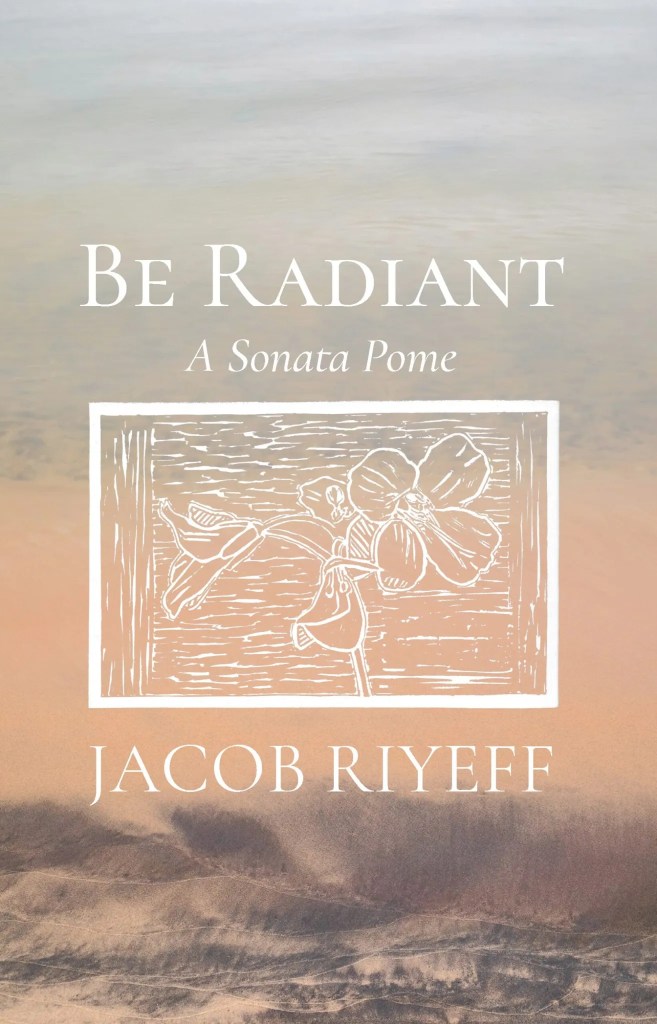
hey folks: it’s been a busy day, but i wanted to get this out before i retire for the evening. because today my second poetry collection, be radiant: a sonata pome,has been published by fernwood press!
this collection is everything from right before the pandemic to about a year ago, including some prints i’ve made for illustrations (was very pleased fernwood allowed me to get some visual work in the collection too). my copies are still en route, so i haven’t yet seen and held it, but today is the official release.
readers of this blog will see familiar material in a whole section of the collection devoted to the state natural area poems. 🙂
the blurbs (from very gracious fellow poets) are below, and you can order a copy here if you like and want to support my work. wishing everyone a peaceful night!
Faced by the specter of eco-catastrophe, what can we do to ward off anxiety and paralysis? We can contemplate and celebrate, as Jacob Riyeff does in this volume, that patch of the Earth which is our patrimony. Microscopically observed and lovingly curated, these lyrics articulate, layer by layer, a Midwestern landscape and time-scape radiant with the often-hidden beauty of life. Archaeology, geology, and botany fuse in a poetry that invites readers to unearth and reverence their own inheritance in our anything but common, Common Home.
–Laurentia Johns OSB, Stanbrook Abbey, England
Jacob Riyeff’s Be Radiant does precisely what it proclaims. Riyeff’s poetry comes in a variety of styles and forms, but each poem radiates with a sense of time and place. Riyeff, like the fungi he loves so much, is a poet rooted in place. His poems reflect this rootedness. Riyeff, as a scholar, is also rooted in the English language. He weds these two in poems like “The Ruin,” which is a translation of an Old English poem, and yet Riyeff places it before a burial mound in his home of Milwaukee. Consume these poems, and you will find yourself radiant as well.
–David Russell Mosely, poet and theologian
“Adaming creation beyond the Fall,” Jacob Riyeff-a Blakean hybrid of poet, mystic, and illuminator-brings us a new collection that visits “Paul the hermit in the desert”-but still has time to paddle his daughter out past the breakers under an afternoon sun. We see touches of earthy Kerouac, of nature-loving Wordsworth, all against a soaring, ancient spirituality. In “Spring Ephemerals,” he records, with telegraphic, haiku-like focus, intricate images of the damaged Wisconsin wilderness-dovetailing, later, with his translation of the Old English poem “The Ruin.” The sequence “Leads and Diggings” excavates his own family history through voice and narrative-and extends its core sample through the strata of geologic time. This poet is a hybrid of many pasts and worlds-in other words, an American original.
–Amit Majmudar, author of Twin A and What He Did in Solitary
I had the distinct privilege yesterday of having a conversation with Abbot Primate Gregory J. Polan, OSB and Rachel McKendree of Paraclete Press about the practice and virtues of the Divine Office (also known as the Liturgy of the Hours) and my new book, The Saint Benedict Prayer Book.
We discussed a bit of the history but more so the vision of reality that is conveyed by the performance of the Hours, why it matters as a form of prayer in the world today and how it shapes who we are. It was a fabulous discussion with much wisdom from Abbot Primate Gregory.
If you have an interest, you can watch the full conversation here, and you can pick a copy of the book here.
Very happy and humbled to announce the publication of The Saint Benedict Prayer Book. Those who read this blog from time to time for my verse might not be as familiar with my work on western monasticism, but Benedictine culture and thought are primary passions and preoccupations of mine in professional and personal capacities. Years of practice as a Benedictine oblate and of studying the texts that Benedictines have left us from the tenth thru the twentieth centuries have come together in this book in a way that leaves me grateful.
The volume features Little Offices, Commemorations, and Litanies, many of which have been sitting unused for centuries in manuscripts and for decades in scholarly editions. As Fr. Cassian Folsom, OSB says in his Foreword, these prayers are “deeply rooted in the liturgical life of the Church,” with most of them serving as a kind of “adornment” for the Liturgy of the Hours in the Latin Church’s offering of prayer to the Father thru the Son in the Spirit.
Any monastic, oblate, or anyone who is just curious about a 1,500-year tradition of religious life, culture, and liturgical experimentation should find something of value in this book. I offer it to the world ut in omnibus glorifecetur deus.
If you’re interested in a preview or a copy, you can find it here on Paraclete’s site. Thanks for reading!
 Jacob Riyeff