hey all. if you’ve gotten updates from me long enough, you’ll know that, in the midst of lots of hikes and plants and scholarly musings on medieval monasticism, sometimes things get theological/spiritual here.
if you’re game for that, i’ve got a new “eco-theological” essay out on focolare media’s website today. you can read it there or listen to me read it as there’s an audio option.
i’ve been looking for a place to use st. gregory the great’s observation that “the earth has given birth to us all; we are right to call her our mother,” and this is it!
In the interest of continuing to promote appreciation of Old English poetry and the anonymous poets behind the poems, and because it’s Friday, here’s a reading of an Old English poem.
This poem appears in the Exeter Book between the two big sets of riddles. It may not actually be a fragment, and you can see from the editorial title (“Homiletic Fragment II”) that it hasn’t received much love from editors and scholars of Old English literature. But I think it’s a nice little work, offering an exhortation to wisdom in light of the sweep of salvation history, and based in part on Ephesians 4:5-6. It does a lot in a little bit of room.
I thought it was interesting enough to have Br. Paul Quenon, OCSO and Sr. Sarah Schwartzberg do readings of the poem in a forum essay I did in the journal Religion & Literature too, and they mined monastic riches from it readily.
Anyhow, here’s the poem and my translation. It’s included in my chapbook Lofsangas: Poems Old and New, which features translations of oft-neglected Old English poems like this one.
In honor of today beginning Fall Embertide, the Quatuor Tempora (Four Times) of fasting and prayer that go way back in the Latin Church, here is a poem from my 2018 collection Sunk in Your Shipwreck, “My Embering.”
(For any liturgy buffs: I do know that in the Extraordinary Rite ordo for this year the Fall Ember Days are moved to next week, but it’s b/c of a technicality of the 1962 reform that I’m not worrying about–since I don’t follow the old rite anyhow, I’m sticking with the prior 1400+ year tradition.)
I’m delighted to (belatedly) announce that my translation of the Old English poem “The Ruin” appears in the newest issue of Presence, a great journal run by great people.
I read the poem in the audio file below, but here’s some basic context too:
“The Ruin” is a poem found in the tenth-century Exeter Book, which is the first anthology of English poems and a great treasure of English speakers’ literary inheritance. The poem is spoken by an Anglo-Saxon as he stands before what seems to be a Roman ruin in Britain, and he meditates on the transience of culture and human life as he marvels at what the ruin suggests about the creative energies that once existed where he stands. In my translation, I take this scene and “update” it to a Euro-American standing in front of a Middle Woodland burial mound in Milwaukee, WI’s Lake Park, with the same kind of brooding on transience etc.
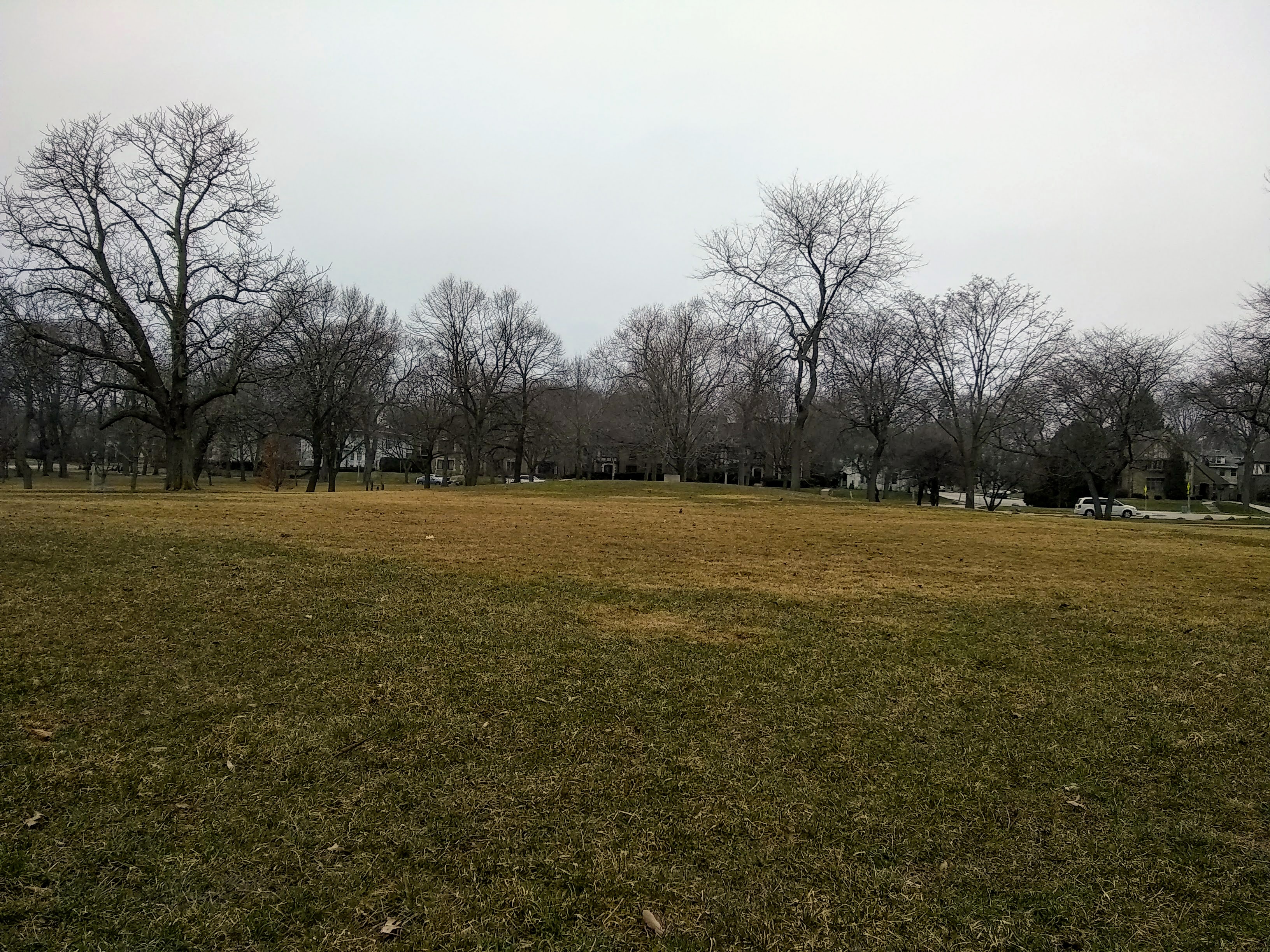
The picture below shows the Lake Park mound (the green slope between trees with the stone marker on top) and the audio provides a reading of part of the original Old English and of the whole Modern English translation.
I hope you enjoy what was an immensely rewarding project for me.
This coming Tuesday, November 26th at 7 pm, anyone in the Milwaukee area who wants to support translators and/or the literary arts in general should come on down to Boswell Book Company on Downer Ave. (more details on their homepage).
I’ll be talking about and reading from my translation of Swami Abhishiktananda’s French poems (In the Bosom of the Father), along with Dr. Lorena Terando of UW-Milwaukee and former Boswellian Caroline Froh.
After brief readings from each of us, we’ll have a Q&A about translation in general and the works themselves.
If you’re in the Milwaukee area and want to support the arts, please attend a reading that Dr. Tyler Farrell and I will be offering at the Haggerty Museum of Art on Marquette University’s campus. It’s a great space, and free and open to the public! I’m particularly excited about this reading as I’ll be reading from my translation of Dom John Lydgate’s Troy Book (the great and massive fifteenth-century poem about the Trojan War) for the first time in public.
Here are the bios, plans, and contact info for the venue:
Tyler Farrell is a Visiting Assistant Professor in the English department at Marquette University and teaches writing, poetry, drama, Irish and British Literature and film. He also leads two study abroad programs, one to London in J-session and the other to Ireland in Summer. He has published three books of poetry with Salmon: Tethered to the Earth(2008), The Land of Give and Take (2012) and will be reading primarily from his most recent collection, Stichomythia(2018). Farrell is a fan of poetry and art and always feels the wonders that art forms can bring to us. Go poetry!
Jacob Riyeff is a Visiting Assistant Professor in the English department at Marquette University. In addition to teaching, he is a translator, poet, and scholar of medieval literature. Jacob’s publishing projects mainly center on the poetry of the Benedictine monastic community down thru the ages, and his books include a translation of the tenth-centuryOld English Rule of Saint Benedict (Cistercian Publications); a translation of the collected poems of Dom Henri Le Saux (aka Swami Abhishiktananda), In the Bosom of the Father (Resource); and his own poetry collection, Sunk in Your Shipwreck (Resource). He will be reading from his collection and a couple new poems.
For more information, contact Lynne Shumow at lynne.shumow@mu.edu
 Jacob Riyeff