Translation of the Old English “Ruin” in Presence–Audio

I’m delighted to (belatedly) announce that my translation of the Old English poem “The Ruin” appears in the newest issue of Presence, a great journal run by great people.

I read the poem in the audio file below, but here’s some basic context too:

“The Ruin” is a poem found in the tenth-century Exeter Book, which is the first anthology of English poems and a great treasure of English speakers’ literary inheritance. The poem is spoken by an Anglo-Saxon as he stands before what seems to be a Roman ruin in Britain, and he meditates on the transience of culture and human life as he marvels at what the ruin suggests about the creative energies that once existed where he stands. In my translation, I take this scene and “update” it to a Euro-American standing in front of a Middle Woodland burial mound in Milwaukee, WI’s Lake Park, with the same kind of brooding on transience etc.

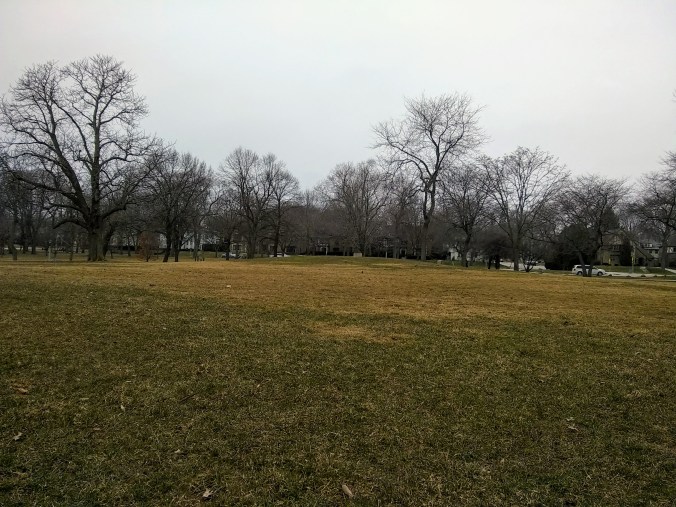
The picture below shows the Lake Park mound (the green slope between trees with the stone marker on top) and the audio provides a reading of part of the original Old English and of the whole Modern English translation.

I hope you enjoy what was an immensely rewarding project for me.
lake park mound


state natural area poems #2a: warnimont bluff fens

[this first installment reflects that i was not permitted access to the actual site–for my own safety and the safety of the rare and delicate plant communities that inhabit the bluffs]


your calcareous fens too rare

the dnr won’t let us find you–

i respect the hell out of that


Warnimont Bluff Fens–home to a thriving community of state-threatened False Asphodel

warnimont bluffs

warn 2

Thanks again, Milwaukee County, for caring for this land for us.

Happy Birthday Dame Gertrude More!

The sisters at Stanbrook Abbey reminded me this morning that it’s Dame Gertrude More’s birthday today–March 25, 1606!

Though she was a totally enclosed, contemplative nun, her friends and her spiritual father all said that she was a very personable, energetic, and friendly woman. Always wanting to talk and joke–even with her great respect for silence in the Benedictine tradition too. Reminds me of many monastics I know!

If you’re on the hunt for down to earth but still intensely profound writing on the mystical life, Dame Gertrude is a good bet. Here‘s a link to my new book of her shorter works.

New Project for the Pandemic Era…

To maintain sanity, encounter the natural world in my area, and keep the literary instincts moving if not honed, I’m going to start a new project here and on Twitter. (Yes, I’m on Twitter now at @riyeff–those who know me personally will be shocked, I’m sure!)

I’m going to visit the State Natural Areas of Milwaukee County and the four adjacent counties to practice social distancing but also maintain an intimate connection to the natural spaces around my neck of the woods. Then to try to forge some kind of virtual connection with anyone who’s interested, I’ll take a photo and make an impromptu three-line poem (not a haiku unless by accident), posting them here and on Twitter. Maybe other folks will share theirs from other natural areas?

That’s the idea; we’ll see where it goes…

Dame Gertrude More Book Now Available!

In this very strange time in the world, I’d like to offer at least a small bit of good news: my new book, an edition of the poems and shorter prose works on prayer and contemplation of Dame Gertrude More, is now available!

Dame Gertrude was a seventeenth-century Benedictine. A great-great-granddaughter of Saint Thomas More, she left home at 17 to co-found the Abbey of Our Lady of Comfort in what is today Cambrai, France. This monastery was part of a movement to revive monastic life among English Catholics after the Reformations and was so successful that the community continues today as Stanbrook Abbey back in England.

Dame Gertrude More was a strong, talkative, and likable woman who, under the tutelage of Dom Augustine Baker, also became a great lover of contemplation. She wrote poems, several shorter prose works, and a longer work sometimes called her “Confessions,” all of which were published in 1658, years after her early death. This book made her one of the earliest women published in the English language.

Her works celebrate and describe the nature of contemplation and divine union. With a plain style that was unconcerned with technicalities and intellectual hair-splitting, Dame Gertrude’s teachings on prayer and contemplation are beautiful testaments to the value of pursuing, as she puts it, “the one thing necessary” (experiential intimacy between the soul and its Maker).

She, Dom Augustine Baker, and the community at Cambrai more generally were instrumental in passing on the ancient and medieval teachings on contemplation in the Christian west, and I am delighted that both the community at Stanbrook Abbey and Gracewing have helped me to make Dame Gertrude’s works more readily accessible to a new generation.

I hope that in this uncertain time, we might find some solace in the kind of unwavering attention Dame Gertrude gives to what is most pressing and important in this earthly life.

You can find a copy on Gracewing’s website and on Amazon. I hope you enjoy!

Translation Night at Boswell Book Company! Nov 26th at 7 pm

This coming Tuesday, November 26th at 7 pm, anyone in the Milwaukee area who wants to support translators and/or the literary arts in general should come on down to Boswell Book Company on Downer Ave. (more details on their homepage).

I’ll be talking about and reading from my translation of Swami Abhishiktananda’s French poems (In the Bosom of the Father), along with Dr. Lorena Terando of UW-Milwaukee and former Boswellian Caroline Froh.

After brief readings from each of us, we’ll have a Q&A about translation in general and the works themselves.

Hope to see folks there!

Poetry Reading at Haggerty Museum of Art October 24th, 2.00 pm

If you’re in the Milwaukee area and want to support the arts, please attend a reading that  Dr. Tyler Farrell and I will be offering at the Haggerty Museum of Art on Marquette University’s campus. It’s a great space, and free and open to the public! I’m particularly excited about this reading as I’ll be reading from my translation of Dom John Lydgate’s Troy Book (the great and massive fifteenth-century poem about the Trojan War) for the first time in public.

Here are the bios, plans, and contact info for the venue:

Tyler Farrell is a Visiting Assistant Professor in the English department at Marquette University and teaches writing, poetry, drama, Irish and British Literature and film. He also leads two study abroad programs, one to London in J-session and the other to Ireland in Summer. He has published three books of poetry with Salmon: Tethered to the Earth(2008), The Land of Give and Take (2012) and will be reading primarily from his most recent collection, Stichomythia(2018). Farrell is a fan of poetry and art and always feels the wonders that art forms can bring to us. Go poetry!

Jacob Riyeff is a Visiting Assistant Professor in the English department at Marquette University. In addition to teaching, he is a translator, poet, and scholar of medieval literature. Jacob’s publishing projects mainly center on the poetry of the Benedictine monastic community down thru the ages, and his books include a translation of the tenth-centuryOld English Rule of Saint Benedict (Cistercian Publications); a translation of the collected poems of Dom Henri Le Saux (aka Swami Abhishiktananda), In the Bosom of the Father (Resource); and his own poetry collection, Sunk in Your Shipwreck (Resource). He will be reading from his collection and a couple new poems.

For more information, contact Lynne Shumow at lynne.shumow@mu.edu